Daikin A5 error code
An A5 on a Daikin split is a protective stop rather than a breakdown. The indoor coil either dropped below freezing in cooling or climbed too hot in heating, so the unit shut itself down. The most common trigger is a dirty filter or blocked airflow, and the code clears by itself once the coil temperature returns to normal.
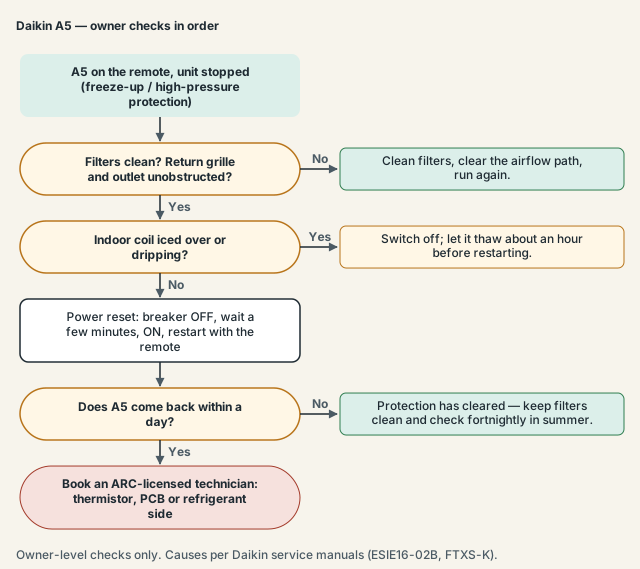
Safety first: in Australia, anything involving refrigerant needs an ARC-licensed technician, and anything behind an electrical cover needs a licensed electrician. Everything on this page is limited to checks you can do from outside the unit with the power off at the switchboard. A thawing indoor coil can drip water from the front of the unit; switch it off and let it drain rather than running it iced up.
Why a Daikin shows A5
Daikin's Australian manuals describe A5 two ways depending on the model: "high pressure control or freeze-up protector" in the Cora and Alira manuals, and "freeze-up protection or heating peak-cut control" in the Zena manual. Both point at the same thing — a control routine on the indoor unit that stops the compressor when the indoor heat exchanger reaches a temperature limit.
The service manuals give the exact limits. In cooling, A5 is raised when the indoor heat-exchanger temperature falls below 0 °C: the coil is icing up. In heating, it is raised when that same coil goes above 65 °C, which Daikin calls heating peak-cut or high-pressure control. Either way the effect is the same — "unit will stop operating" — and the reset is "automatic reset when temperature is within range".
That last line matters. Unlike a U4 communication fault, which needs a power reset, A5 releases itself once the coil warms up or cools down. If the unit restarts on its own after twenty minutes and runs normally, the protection did its job. If it stops again within the hour, whatever starved the coil of airflow is still there.
What causes the A5 error?
Daikin's cause list for A5 is short and it starts with airflow, not electronics. The FTXS-K and ESIE16-02B service manuals list, in order: a short-circuited air passage, a clogged air filter, dust on the indoor heat exchanger, a defective indoor heat-exchanger thermistor, and a defective indoor unit PCB. The SM-TS3 chart sums it up as "clogged filter, defective thermistor".
The logic is simple. A cooling coil needs warm room air passing across it to stay above freezing; take the air away and the refrigerant chills the metal to 0 °C and ice forms. In heating the coil needs air to carry heat away; block it and the coil overheats.
| Cause (Daikin service manual) | What it looks like at home | Who fixes it |
|---|---|---|
| Short-circuited air passage | Curtain, blind, shelf or cupboard door right in front of the outlet, so cold air is drawn straight back into the return | Owner — move the obstruction |
| Clogged air filter | Grey felt on the mesh behind the front panel; weak airflow; unit "sweating" | Owner — wash the filters |
| Dust on the heat exchanger | Filters clean but the fins behind them are furred; often on units never serviced | Technician coil clean |
| Faulty indoor heat-exchanger thermistor | A5 with clean filters and normal airflow; may alternate with C4 |
ARC-licensed technician |
| Faulty indoor PCB | Everything else checked; code returns regardless | ARC-licensed technician |
Low refrigerant charge is often blamed for a frozen coil, and it can cause one, but it is not in Daikin's A5 cause list. Daikin has a separate code, U0, for refrigerant shortage. If a technician suspects gas, that is a refrigerant-side job and needs an ARC licence.
How do I clear a Daikin A5 code?
You mostly wait. Daikin's reset for A5 is automatic once the coil temperature is back in range, so the first step is to switch the unit off at the remote and let a frozen coil thaw. Then fix the airflow — nearly always the filters — before restarting. A breaker reset is not required, though it does no harm if the OPERATION lamp is still blinking afterwards.
A sensible sequence:
- Switch the unit off with the remote. If you can see frost on the coil through the louvre or the unit is dripping, leave it off until the dripping stops.
- Open the front panel and remove the air filters, following Daikin Australia's filter-cleaning FAQ for the Cora or the cleaning section of your own manual.
- Vacuum or wash the filters, let them dry fully, and refit them.
- Look at the room. Anything within arm's reach of the outlet or the top-of-unit return grille that could send cold air straight back in should be moved.
- Restart in the same mode. Run for thirty minutes and check the code again with the remote.
Daikin's manuals do not give a thaw time for a frozen coil; in a warm room twenty to forty minutes is typical. If the code was A5 in heating, the coil will be back in range within minutes of the compressor stopping.
Cleaning the filters properly
Filter cleaning is the one job Daikin's own cause list and its owner FAQ both point to, and it is entirely outside the electrical parts of the unit. Daikin's manuals say to stop operation before cleaning. Daikin Australia's "How to clean your Cora Split System filter" FAQ walks through the front panel and filter removal for the current wall splits, and your own manual has the same steps for your model.
Wash the mesh filters in cool water — a soft brush and a little detergent for stubborn grease — and dry them in the shade, not the sun. Do not refit them wet; a damp filter grows mould and smells the first time the unit runs. Daikin's manuals do not tie a cleaning interval to A5; a check every few weeks through summer is reasonable, and kitchens, pet households and smokers' homes need more.
If the filters come out clean but you can see grey fur on the aluminium fins behind them, the heat exchanger itself is dirty. That is step three of Daikin's flowchart and it is a technician job: the fins are sharp, they sit next to the drain tray and the electrics, and a proper coil clean uses a spray wand and a catch bag. A filter spray is fine for the filters; it is not a substitute for a coil clean.
What to check before you call a technician
A5 is the Daikin code most likely to be fixed for free, so run through this list before booking anyone. Everything here is done with the unit off at the remote and without removing anything but the filters. If the code comes back after the list, tell the technician what you did — it moves the diagnosis straight to the thermistor and board.
- Read the code again with the CANCEL procedure and confirm it is
A5and notA1orC4, which look similar on the display. - Check the filters. If you cannot remember cleaning them, they are the cause. Wash, dry, refit.
- Look at the fins behind the filters with a torch. Furred fins mean a coil clean is due.
- Check the airflow path. Nothing stacked on the unit, no curtain across the outlet, louvres opening fully.
- Check the mode against the weather. Cooling on a cold, damp night with a low set-point is the classic way to ice a coil on a healthy unit.
- Note the timing.
A5after twenty minutes every time suggests airflow;A5at random with clean filters suggests the thermistor. - Write down the model number from the sticker on the indoor unit before you ring.
If the code returns with clean filters, a clear room and a coil that looks clean, stop resetting and book a technician. Daikin's flowchart from that point is thermistor test, then PCB — both parts behind the cover.
Does the unit size matter?
It can. A split that is far too large for the room reaches the set temperature quickly, cycles off, and never runs long enough to move a steady volume of air across the coil; combined with a low set-point that pattern encourages icing. It is not a Daikin-listed cause, but it explains why some units show A5 in a small bedroom and never in the lounge.
If you are replacing a unit that has given repeated A5 codes, check the sizing rather than copying the old capacity. The air con size calculator gives a starting range for Australian rooms by state and construction.
Related Daikin codes
A5 sits in Daikin's indoor-unit group. Its neighbours are A1 (indoor PCB), A6 (indoor fan motor) and C4 (indoor heat-exchanger thermistor). C4 is the one to watch: the same thermistor that triggers A5 protection reports C4 when it fails outright, so a unit that alternates between the two almost certainly has a sensor problem.
On the outdoor side, F6 is the cooling-mode high-pressure control and F3 the discharge-pipe temperature control — both protective stops like A5, but on the outdoor unit. E7 is the outdoor DC fan motor fault. Every code with its unit and meaning is on the Daikin error code list, and the remote symbols guide covers the CANCEL button and the other icons on ARC remotes.
Frequently asked questions
Is A5 a serious fault on a Daikin?
Usually not. A5 is a protection routine, listed as "freeze-up protection" and "heating peak-cut control" in Daikin's manuals. It stops the compressor before ice or heat can damage anything and resets itself when the coil temperature normalises. It becomes serious only when it recurs with clean filters and clear airflow, which points to the thermistor or PCB.
Can I keep using the air conditioner with an A5 code?
The unit decides that for you: it stops when A5 is raised and restarts when the coil is back in range. Letting it cycle like that for a week is poor practice — a coil that ices repeatedly sheds water into the tray and can overflow onto the wall. Clean the filters and fix the airflow first.
Why does my Daikin show A5 only in cooling?
Because the cooling trigger — coil below 0 °C — is the one a dirty filter reaches first. In cooling the coil is already near freezing at full output, so losing airflow tips it over quickly. In heating the coil has to reach 65 °C, which takes a heavier blockage. Cool damp nights with a low set-point make it worse.
Does A5 mean low refrigerant?
Not according to Daikin. The A5 cause list is airflow, filter, dust, thermistor and PCB; refrigerant shortage has its own code, U0. A low charge can freeze a coil, so a technician may still check it if the airflow side is clean, but that is a refrigerant job requiring an ARC licence, not something to test at home.
Will cleaning the filters fix A5 on a ducted Daikin?
The same protection exists on ducted and cassette units, but the filter is in the return-air grille in the ceiling or wall rather than in the head unit, and the code appears on the wired controller as "Error: Push Menu button". Clean the return-air filter and check every zone outlet is open before calling.
Sources and manuals checked
The meaning, detection limits, cause list and automatic-reset behaviour of A5 are taken from Daikin's Australian Cora and Zena operation manuals and from Daikin's FTXS-K, ESIE16-02B and SM-TS3 service documents. Daikin's manuals do not state a thaw time or a filter-cleaning interval specific to A5; the timings above are general guidance. Costs are from a Queensland repair-cost guide, not from Daikin.
- Daikin Australia — Cora FTXV20–71WVMA Operation Manual, 3P651499-4 (Fault diagnosis by remote controller) (official)
- Daikin Australia — Zena FTXJ25/35/50PVMA Operation Manual, 3P369488-1 (official)
- Daikin — RA R32 Split & Multi M-Series Service Manual ESIE16-02B, Part 2 Troubleshooting (A5, p. 22) (official)
- Daikin — FTXS/ATXS-K Series Service Manual, A5 detection and flowchart (p. 72) (official)
- Daikin — Simple Self-Diagnosis by Malfunction Code (SM-TS3 code chart) (official)
- Daikin Australia — FAQ: How to clean your Cora Split System filter (official)
- Fused Air Conditioning (QLD) — Air Conditioning Repair Costs in Australia 2026 (service and PCB ranges) (secondary)