No hot water: what to check first
When there is no hot water, the first check is the same for every system: the switchboard. An electric storage heater needs its "HOT WATER" isolator and fuse on, and on an off-peak tariff it only heats during controlled hours. Gas storage needs gas and a lit pilot. Continuous flow needs 240 V power, gas and enough tap flow. Everything else is licensed trade work.
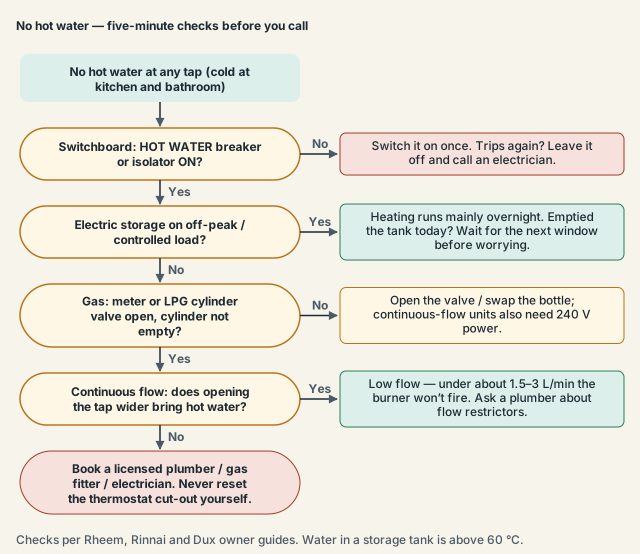
Safety first: gas appliances in Australia may only be worked on by a licensed gas fitter, and anything behind an electrical cover needs a licensed electrician. Water leaving a storage tank can be above 60 °C. The checks here stop at the isolation valves and the switchboard. Rheem and Dux both state that a tripped over-temperature cut-out must not be reset by the owner; the heater must be serviced first.
Electric storage: start at the switchboard
Rheem's electric owner's guide opens its "Save a Service Call" list with the switchboard: inspect the isolating switch marked "HOT WATER" or "WATER HEATER", then check the fuse or breaker with the same label. A tripped breaker is the one no-hot-water cause you can fix in thirty seconds, so look there before ringing anyone.
Reset the breaker once. If it trips again, leave it off — Rheem says all repairs must be made by an approved plumber, and Dux's Proflo manual allows the cover off only by an authorised person after "the electrical power supply switch must be turned off and the fuse removed or the circuit breaker isolated". The thermostat is also on Rheem's list: you "may choose to have your electrician check and adjust the thermostat upwards". A lukewarm tank is an electrician's question.
Why has my off-peak hot water gone cold?
Because off-peak heaters only heat when the network lets them. Rheem's guide puts it plainly: "If on an Off-Peak or time controlled electricity supply, remember heating hours are restricted." Use a full tank in the evening and nothing replaces it until the controlled-load window opens, which YourHome says is usually overnight or early morning.
The hours depend on the tariff. In Queensland, Ergon Energy's Tariff 31 gives "at least 8 hours/day (switch off times vary)" for 250 L and larger tanks; Tariff 33 gives "at least 16 hours/day" for 125 L and larger electric tanks, 270 L heat pumps and 160 L solar tanks, and the times "can change day to day." Rheem's advice is to ask your electricity provider; New South Wales controlled-load hours were not verified for this page.
So the test for an off-peak tank is time: cold water in the evening after heavy use is normal; cold at 7 am after a quiet night is a fault. If the tank is undersized, the hot water sizing tool shows the right size.
Runs out fast? The cut-out, the TPR valve and capacity
No hot water anywhere, at any time, is a supply, ignition or element fault. Hot water that arrives but runs out early is a capacity or loss problem; Dux lists the causes as a TPR valve discharging excessively, an undersized unit, high-use outlets, leaking pipes or dripping taps, and a tripped thermal cut-out. Two of those are safety devices owners misread.
The over-temperature cut-out trips when the tank overheats, which means the thermostat has already failed. Rheem's guide is blunt: "If the over-temperature cut-out operates, it must not be reset and the water heater must be serviced by a qualified person." Dux says the same: "Do NOT reset the thermal cutout until the water heater has been serviced." Behind the cover it is 240 V, so the person who resets it is a licensed electrician.
The temperature and pressure relief (TPR) valve is meant to drip. Rheem calls it "normal and desirable" for the valve to release about 1/50 of the hot water used during heating, and adds that "if it discharges more than a bucket full of water in 24 hours, there may be another problem". Dux says continuous leakage points to excessive supply pressure, a failed valve or a thermostat fault. The only owner action is the easing lever: Rheem says operate it every six months; Dux says raise it gently for a few seconds to dislodge debris.
A tank that lasts half as long as it used to is most often a failed element or a low thermostat — electrician work. A tank that has always run out is a sizing problem: YourHome and CHOICE both allow about 50 litres per person per day.
Gas storage: the pilot and the gas supply
A gas storage tank with no hot water has usually lost its pilot flame, its gas, or both. Check the gas is on at the meter or cylinder and that other gas appliances light. Then relight following the steps for your model: Rheem's troubleshooting page refers owners to the owner's guide and to Rheem's pilot relighting videos, and because the steps differ between models this page gives no generic sequence.
If the pilot will not light after two or three attempts, or lights and goes out, call a licensed gas fitter — Rheem's gas storage guide says the heater "must be installed and serviced by a qualified person". Rheem also says gas storage "must be set no lower than 60 °C".
Continuous flow: power, gas and flow
An instantaneous gas heater has no tank, so "no hot water" means it is not lighting. Three things stop it. Power: the unit needs a 240 V earthed power point, so a switched-off outlet, a tripped breaker or a blackout leaves it dead. Gas: the valve at the heater, meter or cylinder. Flow: the tap must pass enough water to trigger ignition.
Flow is the one owners miss. Rheem's troubleshooting page says "the flow of hot water is not adequate to keep the water heater operating. This can be caused by flow restrictors and water saving low flow taps", and asks a plumber to "increase your hot water flow rate to a minimum of two to three litres per minute". Rinnai's own Infinity figure is lower, at 1.5 L/min, but the test is the same: if a full-bore laundry tap lights the unit and a low-flow basin tap does not, the tap is the problem.
If the unit has a controller, read the code — a Rinnai 11 means no ignition or no gas supply; see Rinnai error code 11. And note Rheem's point: "If you have a 50°C temperature limited water heater, then hot water to your whole house will be limited to 50°C."
What to check before you call anyone, and who to call
Run through this list first; it is what the service desk will ask, and it separates the thirty-second fixes from the booked visits. None of it goes behind a cover or past an isolation valve, and where a step reaches a reset the manual forbids, that is the cue to ring the trade.
- Switchboard. "HOT WATER" isolator on; breaker or fuse intact. Reset once only.
- Tariff timing. On off-peak, wait for the next heating window — overnight for most homes.
- Cut-out. If it has tripped, do not reset it. Book an electrician.
- TPR valve. A drip while heating is normal; a bucket in 24 hours is a plumber's job.
- Gas. Valve open at the heater and at the meter or cylinder; other gas appliances lighting.
- Pilot. Relight per your owner's guide or Rheem's videos; two failures means a gas fitter.
- Continuous flow. Power point on, tap fully open, any controller code noted.
- Paperwork. Model, litres, install date and warranty from the compliance plate.
Which trade depends on what has failed. Water connections, the TPR valve, leaks and a full replacement are plumbing. Pilot faults, gas valves and a continuous flow unit that will not ignite with gas on are a licensed gas fitter. Elements, thermostats and the cut-out sit behind a 240 V cover: a licensed electrician.
Whoever comes, one rule applies to the whole system. YourHome states that storage must be heated to at least 60 °C to control Legionella, that delivery to bathrooms is reduced to 50 °C, and that "by law, all new hot water systems are required to have a tempering valve fitted."
Repair or replace?
Start with the warranty. YourHome says tank warranties "typically range from 5 to 10 years"; Rheem's electric domestic tanks carry a seven-year cylinder warranty and one year on components, with the anode replaced within five years and at most eight. Dux requires a service with anode replacement at five years. A leaking cylinder inside warranty is a claim, not a repair.
Beyond that, no authority source consulted for this page gives a lifespan in years; the "8 to 12" and "15 to 20 years" figures that circulate come from trade blogs, not from CHOICE, YourHome or the manufacturers. A tank past its warranty and anode interval that needs a second repair is a replacement candidate; CHOICE's 2024 unit prices in the Key Facts table give the order of magnitude.
Frequently asked questions
Can I reset the over-temperature cut-out myself?
No. Rheem's electric owner's guide says the cut-out "must not be reset and the water heater must be serviced by a qualified person", and Dux says not to reset it until the heater has been serviced. It trips because the thermostat has already failed. Behind the cover is 240 V, so the reset is electrician work.
How long does an off-peak hot water system take to reheat?
It depends on your controlled-load window, not on the tank. Ergon's Tariff 31 guarantees at least 8 hours of supply a day and Tariff 33 at least 16, with switch-off times that vary. A tank used up in the evening normally reheats overnight; Rheem's advice is to ask your electricity provider for your hours.
Is a dripping TPR valve why I have no hot water?
Usually not. Rheem calls a small discharge during heating — about 1/50 of the hot water used — normal and desirable. More than a bucket in 24 hours is losing hot water; Dux says continuous leakage points to supply pressure, a failed valve or a thermostat fault. Lift the easing lever briefly; if the flow continues, call a plumber.
Why is my hot water only warm, not hot?
Three common reasons. A 50 °C temperature-limited continuous flow unit feeds the whole house at 50 °C by design, as Rheem notes. A tempering valve on a storage system may have failed, delivering cooler water while the tank is fine. Or the thermostat is set low — Rheem refers adjustment to your electrician.
Sources and manuals checked
Switchboard, tariff, thermostat, cut-out and TPR guidance is from Rheem's electric owner's guide and troubleshooting page and Dux's Proflo manual; tariff hours are Ergon Energy's for Queensland only; the 60 °C / 50 °C tempering rule is YourHome's; unit prices are CHOICE's April 2024 figures. Rheem's model-specific pilot relighting steps, New South Wales controlled-load hours and any lifespan in years were not found in the sources, so none are stated.
- Rheem Australia — Hot Water System Troubleshooting Guide (official)
- Rheem Australia — Owner's Guide and Installation Instructions, Electric Domestic (122179 Rev E, Jan 2018) (official)
- Rheem Australia — Gas Hot Water Pilot Light Relighting Videos (official)
- Dux — Proflo Electric Storage Water Heaters Owner's Manual (official)
- Rinnai Australia — Infinity Technical Information (minimum operating water flow) (official)
- Ergon Energy — Residential economy tariffs (Tariff 31 and Tariff 33) (authority)
- YourHome (Australian Government) — Hot water systems (authority)
- CHOICE — How to buy the best hot water system (5 April 2024) (authority)