AstralPool chlorinator showing Low Salt
An AstralPool chlorinator showing Low Salt (or LO S on the E-Series) has measured low conductivity in the water, which usually means the salt has been diluted below the 4,000 ppm target. It can also be a false reading in cold water or a calcified cell. Test the salt with a strip or at a pool shop before adding any bags.
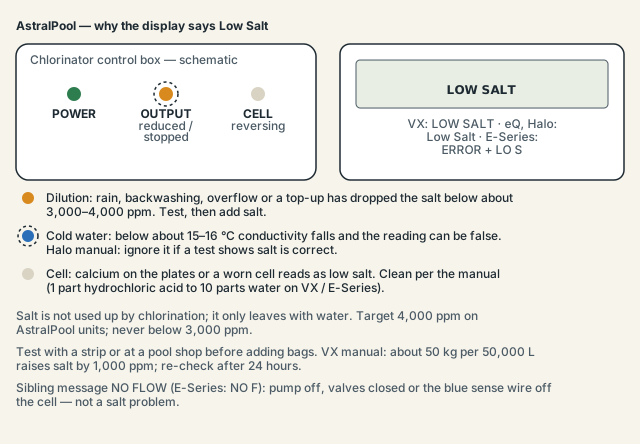
Safety first: handle pool chemicals in a ventilated area, wear gloves and eye protection, always add acid to water (never water to acid), and never mix chlorine products. Electrical work on pumps and chlorinators is licensed work in Australia. Cell cleaning uses hydrochloric acid at 1:10 — do it outdoors, with the chlorinator unplugged, and add the acid to the water.
What does Low Salt mean on an AstralPool chlorinator?
The VX manual puts it simply: "This indicates that the concentration of salt has reduced within your pool." The cell has a sensor that reads the conductivity of the water passing through it, and salt is what makes pool water conductive. When conductivity falls below the threshold, the control box shows the message and cuts chlorine production.
The wording differs by model but the meaning is the same. The Viron eQ and Halo Chlor show Low Salt; the VX series shows LOW SALT; the E25 and E35 flash ERROR with the code LO S. The E-Series remedy is to "take sample of water to retailer and check salt level", then "add salt as recommended" or "clean the cell". That "or" matters: AstralPool's tables list several causes for one message, and only one is fixed by buying salt.
The three things that trigger Low Salt
AstralPool's VX7T troubleshooting table lists four causes under Low salt: the salt has dropped, "pool water temperature is low", "cell has calcified" and "cell has failed". The eQ manual gives the same list in slightly different words. Work through them in that order: the first two cost nothing to check and only the fourth needs a technician.
1. Dilution. Salt is not consumed by the chlorinator; it leaves only with water. The eQ manual lists "filter backwash, water renewal, rain, leaks, etc." and notes that "salt is lost during backwashing and when your pool overflows". After a storm that overflowed the pool, a genuine drop below 3,000 ppm is plausible. If the water has also gone cloudy or green, the green pool after rain guide covers the chlorine side.
2. Cold water. Conductivity falls as water cools, so the sensor reads lower in winter with nothing changed. The Halo Chlor manual is the clearest AstralPool document on this: "When the water is cold (below 16°C), the chlorinator may show 'Low Salt'. If the salt level is actually correct, then this warning can be ignored." The eQ manual says the reading "can vary depending on the temperature and age of the cell". A Low Salt that appears in June and clears in October is almost always this.
3. A calcified or worn cell. The VX manual explains that calcium on the negative plates "may cause false low salt, or no flow condition". Reverse polarity normally keeps the plates clear, but hard water or high pH can outpace it. A worn cell reads low for the same reason; the eQ and VX remedies for "cell has failed" are both "call a technician".
AstralPool salt targets by model
Every current AstralPool manual asks for 4,000 ppm and none allows the pool to run below 3,000 ppm; the E-Series makes that a warranty condition. The table below collects the display wording and the target from each manual so you can match your unit, and the "at 27°C" and "at 25°C" qualifiers show why the cold-water false reading exists at all: the target is really a conductivity target.
Table: AstralPool models, Low Salt wording and salt targets
| Model | Display wording | Recommended salt | Minimum stated | Note from manual |
|---|---|---|---|---|
| Viron eQ (EQ18/25/35) | Low Salt |
4,000 ppm | "never be allowed to fall below 3,000ppm" | Excess salt above 10,000 ppm also cuts output |
| VX 5T/7T/9T/11T | LOW SALT |
"around 4000 ppm" | never below 3,000 ppm | Add "approx. 50kg per 50000 litres" |
| E25 / E35 | ERROR + LO S |
4,000 ppm ("4000 at 27°C") | 3,000 ppm | Running under 3,000 ppm "may cause damage to the cell and will void the warranty" |
| Halo Chlor 18 | Low Salt |
"4000ppm at 25°C" | 3,000 ppm | Below 16 °C the warning "can be ignored" if salt is correct |
Test the salt before you add any
Buying salt on the strength of the display alone is how pools end up at 7,000 ppm by spring. The eQ manual says to "measure the salt concentration in the pool water using a salt tester or a test strip"; the E-Series says to take a sample to a retailer. Either is fine. Then compare the number with the table above.
- Below 3,000 ppm: add salt. The how much salt to add page or the pool salt calculator gives the kilograms for your volume.
- 3,000–4,000 ppm and water below about 16 °C: temperature-driven. Top up if you like, but do not chase the message.
- 4,000 ppm or higher and water warm: the salt is fine; the cell is the suspect.
How much salt does AstralPool say to add?
The VX manual gives the only hard dosing statement in the range: when LOW SALT shows, "add salt at approx. 50kg per 50000 litres of water", a 1,000 ppm lift. The VX7T revision adds a pause: "check again in 24 hours and then if it is still indicated, add two 25 kg bags of salt". The other manuals give no kilogram figure.
The formula behind that 50 kg is kilograms = litres × ppm to add ÷ 1,000,000, so a 30,000 L pool at 3,000 ppm needs 30 kg. Add it at the shallow end with the pump running and allow 24 hours before re-testing. The VX manual's "4kgs of salt for every 1000 litres" is for a fresh fill.
Cleaning a calcified AstralPool cell
If the water is warm and tests at or above 4,000 ppm, look at the cell. White, crusty deposits between the plates are calcium, and they insulate the sensor. Both the VX and E-Series manuals give the same cleaning solution, one part hydrochloric acid to ten parts water, and both say the cell must be disconnected from power first.
The VX procedure (Inst.245) is: close the valves, "disconnect the Chlorinator from the Mains by removing the 3 pin plug", disconnect the cell wires, undo the barrel nuts, then "turn the cell upside down (inlet and outlet on top) and fill the cell with a mix of 1 part Hydrochloric acid to 10 parts water and leave standing for a few minutes". Rinse well and refit with the o-rings seated. The E-Series version immerses the removed electrode for "about 10 minutes" without wetting the terminals.
The VX manual says "the use of eye protection, mask and gloves are highly recommended"; Fluidra's Zodiac LM3 manual for the same cell chemistry adds "ALWAYS ADD ACID TO THE WATER" and that anything stronger than 1:10 damages the electrode. Neither the eQ nor the Halo manual contains a cleaning ratio; Zodiac's troubleshooting page suggests "a cell cleaning solution from your pool professional, as acid can be dangerous", the safer route for those models.
What to check before you call a technician
None of this needs more than a test strip and a torch, and all of it is done with the chlorinator switched off at the power point. Work through the list in order and note what you find; if you do call, the technician will want the salt reading, the water temperature and the age of the cell before anything else.
- Test the salt with a strip, a salt tester or a sample at the pool shop. Write the number down.
- Check the water temperature. Below about 16 °C, treat a Low Salt as unproven until the water warms or a test says otherwise.
- Think back a week. Heavy rain, an overflow, a topped-up pool, a long backwash or a leak all dilute salt.
- Look at the cell. Scale between the plates means a clean, not more salt.
- Check the blue sense wire is firmly on the cell terminal, and that the pump is running with valves open.
- After adding salt, wait 24 hours before deciding it did not work.
Call a technician when the water is warm, the salt tests at 4,000 ppm or more, the cell is clean and the message stays: that is AstralPool's "cell has failed" line. Also call if the display is blank, which the VX manual attributes to no power or a blown "3 amp slow blow" fuse — a fuse change inside the box is technician work under the manual.
No Flow and the Zodiac equivalents
No Flow is the sibling message. The VX manual says it "indicates that the Chlorinator thinks that there is no flow to the cells"; the causes are the pump off, valves closed, or the "blue wire disconnected from cell". On the E-Series it reads NO F. Calcium on the plates can mimic either message, so a cell clean fixes some No Flow cases too.
Owners mix the two Fluidra brands, so briefly: the Zodiac eXO iQ and Clearwater Duo show LOW CONDUCTIVITY for salt under 4,000 ppm "due to water loss or dilution" or a calcified cell, and CHECK OUTPUT for a disconnected or worn cell. The LM3 and TRi use a Check Salt light meaning "between 3000 and 4000 ppm, depending on the water temperature". Zodiac's troubleshooting page also describes a "skimmer test", adding a little salt at the skimmer to see whether the reading moves. The target is the same 4,000 ppm.
Frequently asked questions
Can I keep swimming while the chlorinator shows Low Salt?
Yes. The message is about chlorine production, not water safety on the day. What matters is whether free chlorine stays in the 1–3 ppm range the manuals ask for. Test it, and if it is dropping, hand-dose liquid chlorine while you sort the salt out.
Why does my AstralPool say Low Salt every winter?
Because it measures conductivity, and cold water conducts less. The Halo manual states that below 16 °C the warning may appear and "can be ignored" if the salt is correct. Test in winter, keep the level at 4,000 ppm, and expect the message to clear when the water warms.
Will adding salt damage the chlorinator if the reading was false?
Not directly, but over-salting has costs. The eQ manual lists "excessive salt >10,000 ppm" as a cause of low chlorine production, and the only way down is to drain some water and refill. A 20 kg bag lifts a 50,000 L pool by 400 ppm, so unnecessary bags add up.
Does Low Salt void the warranty?
The message itself does not, but running low does on the E-Series. Its manual says operating "with less than 3000 ppm of dissolved salt in the water may cause damage to the cell and will void the warranty". The other AstralPool manuals use the same 3,000 ppm floor without the warranty wording.
Sources and manuals checked
Display strings, causes, remedies, salt targets and the 1:10 acid ratio are quoted from the AstralPool eQ, VX, E-Series and Halo manuals and the VX7T revision; Zodiac messages from the eXO/Duo manual and Zodiac's troubleshooting page. AstralPool publishes no call-out or cell prices. The eQ and Halo manuals contain no cell-cleaning procedure, and no AstralPool manual uses the wording "Check Cell".
- AstralPool — Viron eQ Salt Chlorinator with Bluetooth Installation Manual, INST 464 (official)
- AstralPool — VX 3 Series Salt Chlorinator Installation and Operating Instructions, Inst.245 (official)
- Fluidra AstralPool — VX7T Owner's Manual (troubleshooting, pp. 19–23) (official)
- AstralPool — E Series Saltwater Chlorinator Owner's Manual, H0712400_REVB (official)
- AstralPool — Halo Chlor Installation and Operation Manual, H0725000_REVC (official)
- Zodiac Australia — Clearwater Duo and eXO Installation Manual, H0633500_REVB (official)
- Zodiac Australia — Your Ultimate Pool Chlorinator Troubleshooting Guide (official)