How much salt to add to a pool
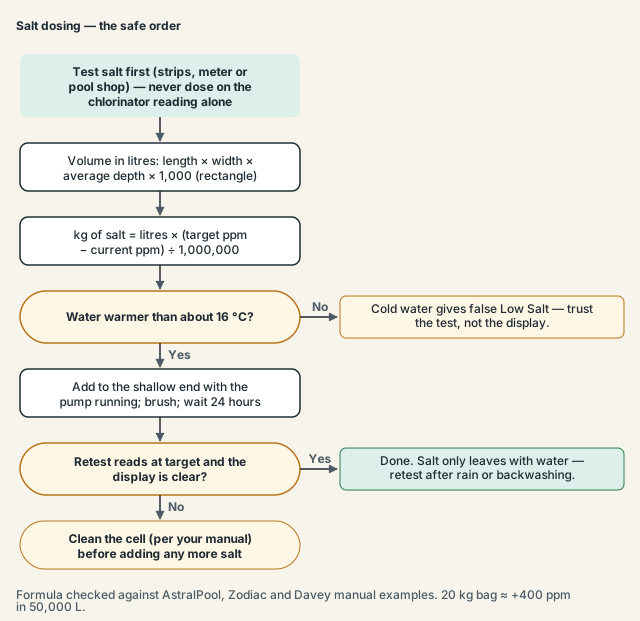
To work out how much salt to add, multiply your pool's litres by the ppm you want to add and divide by one million: that gives kilograms. A 50,000 L pool going from 3,000 to 4,000 ppm needs 50 kg, which is two and a half 20 kg bags. Test first, add at the shallow end with the pump running, and re-test after 24 hours.
Safety first: handle pool chemicals in a ventilated area, wear gloves and eye protection, always add acid to water (never water to acid), and never mix chlorine products. Electrical work on pumps and chlorinators is licensed work in Australia. Pool salt itself is harmless, but a 25 kg bag is a lifting hazard — split it or use a trolley, and keep salt off the skimmer to protect the equipment.
The salt formula and two worked examples
The maths rests on one fact: 1 ppm is 1 mg/L, so raising a litre of water by 1 ppm takes 1 mg of salt. Scale that up and the formula is kilograms of salt = pool litres × (target ppm − current ppm) ÷ 1,000,000. It works for any brand, any bag size and any target, and it agrees with every manufacturer figure on this page.
Example 1 — AstralPool VX top-up. Your 50,000 L pool tests at 3,000 ppm and the VX target is 4,000 ppm. Salt needed = 50,000 × 1,000 ÷ 1,000,000 = 50 kg. The VX manual's own remedy for LOW SALT is to "add salt at approx. 50kg per 50000 litres of water", which is the same 1,000 ppm lift.
Example 2 — Zodiac LM3, one bag. The LM3 manual says "one 25 Kg bag of salt will increase the salt concentration by 500 ppm" in a 50,000 L pool. Reverse the formula: 25 kg × 1,000,000 ÷ 50,000 L = 500 ppm. Correct again.
The check for a fresh fill works too. The VX manual says to "add 4kgs of salt for every 1000 litres of water" and that "a typical pool of around 50 000 L requires 200 kg of salt to initially set-up the pool to 4000 ppm"; 50,000 × 4,000 ÷ 1,000,000 = 200 kg. Davey's EcoSalt2 salt-addition table gives 50 kg for +1,000 ppm in 50,000 L, 100 kg for +2,000 ppm and 200 kg for +4,000 ppm, matching the formula line for line.
What salt level does each brand want?
Most Australian chlorinators are built around 4,000 ppm, but the minimums, maximums and alarm points differ, and a couple of brands sit well away from that number. Check your own manual before you aim for a target; the table below collects the figures from the manuals listed at the end of this page.
Table: Salt targets by chlorinator brand (ppm; 1,000 ppm = 1 g/L)
| Brand / model | Recommended | Minimum or alarm | Maximum stated |
|---|---|---|---|
| AstralPool Viron eQ | 4,000 | never below 3,000 | above 10,000 listed as a cause of low output |
| AstralPool VX 5T/7T/9T | "around 4000 ppm" | never below 3,000 | — |
| AstralPool E25/E35 | 4,000 ("4000 at 27°C") | below 3,000 voids warranty | 7,000 (manual); 8,000 (product page) |
| AstralPool Halo Chlor | "4000ppm at 25°C" | Low Salt below 3,000 | 8,000 |
| Zodiac eXO iQ / Clearwater Duo | 4,000 | LOW CONDUCTIVITY below 4,000 |
7,000 |
| Zodiac TRi | 4,000 | Check Salt at 3,000–4,000 |
— |
| Zodiac LM3 | about 4,000 | never below 3,000 | 13,000 "maximum safe" |
| Davey EcoSalt2 standard | 3,000–6,000 | Add Salt alarm about 3,000; cut-out 2,000 | 6,000 |
| Davey EcoSalt2 "L" low-salt | 1,500–6,000 | Add Salt alarm about 1,500; cut-out 1,000 | 6,000 |
| Waterco Hydrochlor ST / Electrochlor | optimum 5,500 | minimum 4,000 | 6,000 |
| Hayward AquaRite (AU pH kit manual) | 3,200 (3.2 g/L) | 2,700 | 3,400 |
One trap for Zodiac owners: the "low salt" eXO iQ LS and TRi Expert LS are European models. Every zodiac.com.au product page checked states 4,000 ppm, so a Zodiac bought in Australia is a standard-salt unit unless the box says otherwise. The genuine low-salt example sold here is Davey's EcoSalt2 "L", which runs from 1,500 ppm.
How do I work out my pool's volume?
Volume is the number most owners get wrong, and every error in litres becomes the same percentage error in kilograms. If your pool builder or installer wrote a volume on the paperwork or programmed it into the chlorinator, use that. Otherwise measure the pool and use the standard geometry below, with lengths in metres.
- Rectangular: length × width × average depth × 1,000 = litres.
- Round: 3.14 × radius² × average depth × 1,000 (radius is half the diameter).
- Oval: 3.14 × (length ÷ 2) × (width ÷ 2) × average depth × 1,000, which simplifies to about 0.785 × length × width × depth × 1,000.
- Kidney or freeform: approximate as 0.85 × length × width × average depth × 1,000, or break the shape into rectangles and add them up.
- Average depth: (shallow end + deep end) ÷ 2.
A rectangular 8 m × 4 m pool with 1.1 m at the shallow end and 1.9 m at the deep end has an average depth of 1.5 m, so 8 × 4 × 1.5 × 1,000 = 48,000 L. The freeform constants are industry approximations rather than a manufacturer figure.
Bag maths: how many bags is that?
Pool salt in Australia comes mainly in 20 kg bags at hardware and pool retailers (Hy-Clor's Ultra Premium Pool Salt is a 20 kg bag) and 25 kg bags through pool shops, which is the size the AstralPool VX7T and Zodiac manuals both refer to when they say to add "two 25 kg bags". Smaller 15 kg and 12.5 kg bags exist, mostly for mineral blends.
For a 50,000 L pool, one 20 kg bag lifts salt by 400 ppm and one 25 kg bag by 500 ppm. In a 10,000 L plunge pool, a single 20 kg bag adds 2,000 ppm, which is why small pools are so easy to over-salt. Some common cases:
Table: Bags needed for common top-ups (rounded up)
| Pool volume | Lift needed | Salt (kg) | 20 kg bags | 25 kg bags |
|---|---|---|---|---|
| 30,000 L | +1,000 ppm | 30 | 2 (adds 1,333 ppm) | 1 (adds 833 ppm) then re-test |
| 50,000 L | +500 ppm | 25 | 1 (adds 400 ppm) then re-test | 1 |
| 50,000 L | +1,000 ppm | 50 | 3 (adds 1,200 ppm) or 2 then re-test | 2 |
| 50,000 L | fresh fill to 4,000 ppm | 200 | 10 | 8 |
| 75,000 L | +1,000 ppm | 75 | 4 (adds 1,067 ppm) | 3 |
Where a bag count overshoots, it is better to round down, wait a day and re-test than to round up. Salt only leaves the pool with water, so an overshoot is far harder to undo than a shortfall. The pool salt calculator does this arithmetic for your exact litres, current reading and brand target.
How to add salt to a pool
Add the bags at the shallow end with the pump running, then brush any undissolved salt off the floor. Zodiac's Australian guide describes exactly this: "two 25kg bags of salt to the shallow end", run the filter for 6 hours, and "allow 24 hours for full dissolution" before re-testing. The VX7T manual says the same about the wait: check again in 24 hours before adding more.
Do not tip salt into the skimmer box. Davey's EcoSalt2 manual calls it "a poor practice as it allows very high concentrations of salt to be passed through your filtration and other pool equipment". Use pool-grade salt; the manuals refer to "pool salt" throughout, not household iodised or anti-caking salt. On a mineral pool, follow the mineral product's own dosing.
What to check before you buy salt
A Low Salt message is a prompt to test, not an instruction to dose. Several things produce a low reading with the salt perfectly fine, and a couple of them get worse if you add bags. Run through this list with a test strip in hand before you load the car with bags you may not need.
- Test the water with a salt strip, a salt tester or a sample at the pool shop, and write down the ppm.
- Check the water temperature. Halo Chlor says below 16 °C the unit "may show 'Low Salt'" and the warning "can be ignored" if salt is correct; Davey and Hayward give 15 °C. Winter readings are unreliable.
- Look for the dilution event. Rain that overflowed the pool, a backwash, a top-up from the hose or a leak. If none happened, be suspicious of the reading.
- Inspect the cell plates for white scale, which mimics low salt on every brand.
- Confirm the target for your brand from the table above, especially Davey "L" and Waterco owners.
- Calculate the kilograms and round down to whole bags.
- Re-test after 24 hours and only then add a second round.
If the salt tests at or above target and the message stays, the AstralPool Low Salt page covers the cell-cleaning and technician side; the same logic applies to the Zodiac and Davey messages.
Over-salting and getting salt back down
Salt does not evaporate and the chlorinator does not consume it. Davey's manual states it plainly: "Salt is NOT used up in the chlorination process, or by evaporation. It is only lost through dilution caused from: backwashing, splash-out, overflow, leakage from the pool, or plumbing." That is why every bag you add stays until water leaves.
The ceilings vary by brand. AstralPool's eQ manual lists "excessive salt >10,000 ppm" as a cause of low chlorine production and says to reduce salt to 4,000 ppm. Zodiac's LM3 allows a "maximum safe salt level" of 13,000 ppm, while Waterco and Davey stop at 6,000 and Hayward at 3.4 g/L, so an amount that is fine on one unit trips the high-salt alarm on another. The only way down is to drain part of the pool and refill with fresh water: to drop 50,000 L from 6,000 to 4,000 ppm you need to replace a third of the water, about 17,000 L. That is a lot of water and a lot of re-balancing, which is the argument for rounding bag counts down and re-testing.
Frequently asked questions
How many 20 kg bags of salt does a 50,000 L pool need?
For a fresh fill to 4,000 ppm, ten bags (200 kg). For a top-up from 3,000 to 4,000 ppm, two and a half bags (50 kg), so add two, wait 24 hours, test and decide on the third. Every 20 kg bag adds 400 ppm to 50,000 L.
Can I add all the salt at once?
For a new fill, yes, since there is no reading to overshoot; spread the bags around the shallow end with the pump running. For a top-up of more than three or four bags, put in most of it, test after 24 hours and finish the job then.
Why does my chlorinator still say Low Salt after I added salt?
Usually because it has not dissolved yet: both Zodiac and AstralPool say to allow 24 hours. If a test confirms the level is right and the message persists, the cell may be scaled or the water is below about 15–16 °C, which lowers conductivity. Do not add more on the strength of the display.
Does a mineral pool use the same formula?
The chlorinator still needs a conductivity equivalent to its salt target, but magnesium chloride and potassium blends do not weigh the same per ppm as sodium chloride, so the kg = L × ppm ÷ 1,000,000 formula applies only to plain pool salt. Follow the mineral product's dosing chart and the chlorinator's mineral setting where it has one.
Is too much salt bad for the pool?
For the chlorinator, yes. AstralPool's eQ manual lists salt above 10,000 ppm as a cause of low chlorine production, and Waterco and Hayward units raise a High Salt alarm above their 6,000 ppm and 3.4 g/L limits. Since salt can only be removed by replacing water, keep additions conservative and re-test between rounds.
Sources and manuals checked
The formula was checked against the AstralPool VX, Zodiac LM3 and Davey EcoSalt2 figures and matches all of them. Hayward's Australian standard AquaRite manual was not available, so the Hayward row uses the AU pH upgrade kit manual. The freeform volume constant is an industry approximation, and no manufacturer publishes salt prices.
- AstralPool — VX 3 Series Salt Chlorinator Installation and Operating Instructions, Inst.245 (official)
- Fluidra AstralPool — VX7T Owner's Manual (Low Salt remedy, 25 kg bags) (official)
- AstralPool — Viron eQ Salt Chlorinator Installation Manual, INST 464 (official)
- AstralPool — E Series Saltwater Chlorinator Owner's Manual, H0712400_REVB (official)
- AstralPool — Halo Chlor Installation and Operation Manual, H0725000_REVC (official)
- Zodiac Australia — Clearwater Duo and eXO Installation Manual, H0633500_REVB (official)
- Zodiac — LM3 Salt Chlorinator Owner's Manual (official)
- Zodiac Australia — Your Ultimate Pool Chlorinator Troubleshooting Guide (official)
- Davey — EcoSalt2 Installation and Operating Instructions, 403450-13UK (official)
- Waterco — Hydrochlor ST Salt Chlorinator Manual (Sep 2019) (official)
- Hayward Australia — AquaRite+ pH Upgrade Kit Owner's Manual (official)
- Hy-Clor — Ultra Premium Pool Salt 20 kg (official)
- Pool Advisor — Pool Volume Calculator (geometry formulas) (secondary)