Daikin E7 error code
When a Daikin shows E7, the outdoor unit's DC fan motor has failed to start or has locked, and the system has shut down to protect the compressor. Daikin calls it "DC fan motor fault" or "DC fan lock". Owners can power-reset and look through the grille for an obstruction; anything more is a job for a licensed technician.
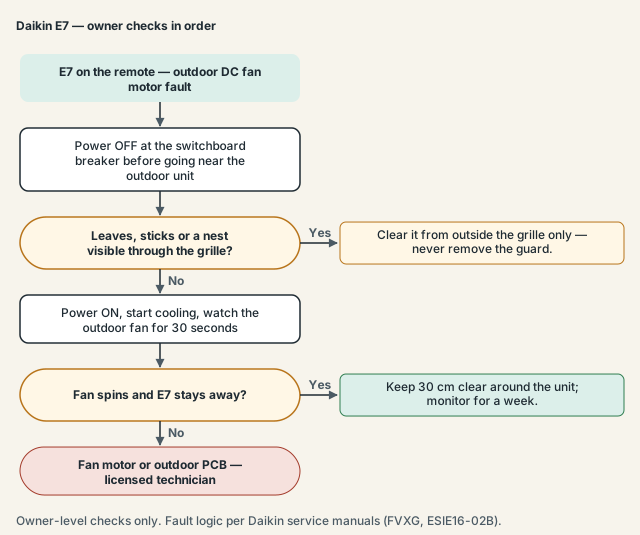
Safety first: in Australia, anything involving refrigerant needs an ARC-licensed technician, and anything behind an electrical cover needs a licensed electrician. Everything on this page is limited to checks you can do from outside the unit with the power off at the switchboard. The outdoor fan is driven from the inverter board's high-voltage DC bus and can start without warning when power is restored — never reach through the grille.
What E7 means on a Daikin outdoor unit
The Cora and Alira operation manuals list E7 as "DC fan motor fault"; the Zena manual calls it "DC fan lock". Daikin's global SM-TS3 chart describes it as "malfunction of outdoor unit fan motor system" and the ESIE16-02B service manual simply as "fan motor abnormality". All four put it in the outdoor-unit group.
The outdoor fan draws air across the condenser coil. Without it, the refrigerant cannot shed heat in cooling or pick it up in heating, and pressure and temperature climb fast. So the outdoor PCB watches the fan closely. According to the FVXG service manual it uses "the high-voltage fan motor rotation speed detected by the Hall IC" — a sensor inside the motor that reports each revolution to the board.
If the fan fails to start rotating within about 15 to 30 seconds of the motor being commanded on, the board logs a fan lock. The ESIE16-02B manual adds that E7 can also be raised by a faulty Hall signal even when the motor is physically turning, which is why a fan that spins is not proof the motor is fine.
What causes the E7 error?
Daikin lists four physical causes in the FVXG service manual — a disconnected fan-motor connector, foreign matter obstructing the fan, a failed fan motor, and a defective outdoor PCB — and the ESIE16-02B manual adds a blown fuse on the outdoor PCB. The SM-TS3 chart's shorthand is "motor failure, harness issues". Only one of those, obstruction, is something an owner can see.
| Cause (Daikin service manual) | Typical story | Who fixes it |
|---|---|---|
| Foreign matter obstructing the fan | Storm debris, a stick through the grille, a bird's nest, ivy growing into the unit | Owner can spot it through the grille; removal is a technician job if it means opening the guard |
| Disconnected fan-motor connector | Recent service or relocation; vibration on an old install | Licensed technician |
| Failed fan motor | Bearing noise for weeks beforehand; fan turns stiffly by hand (technician test) | ARC-licensed technician |
| Blown fuse on outdoor PCB | Sudden E7 after a storm or power surge |
Licensed technician / electrician |
| Defective outdoor PCB | Fan and motor test fine but no rotation-pulse signal at the board | ARC-licensed technician |
Coastal and bush installs are worth a mention. Salt air corrodes the motor shaft and the bearing seals, and leaf litter blows in every autumn. Neither is in Daikin's cause list, but both produce the same end result — a motor that cannot reach speed inside the 15–30 second window.
How do I reset a Daikin E7 code?
Unlike a freeze-up protection code, E7 does not release itself. The ESIE16-02B manual gives the reset as "manual reset via user interface", meaning the fault stays latched until it is cleared from the controller or the power is cycled. Daikin's owner-level instruction for a blinking lamp is the same for all codes: breaker off, restart from the remote, and if the lamp still blinks, read the code and consult your dealer.
Step by step:
- Turn the unit off with the remote.
- Switch off the air conditioner breaker at the switchboard, and the outdoor isolator if there is one on the wall next to the unit.
- Wait a few minutes. Daikin's manuals do not state a time.
- Walk to the outdoor unit and look through the grille while it is powered off. This is the only moment you should be close to it.
- Restore the isolator, then the breaker. Start the unit from the remote in COOL or HEAT.
- Stand back and watch the outdoor fan. It should begin turning within about half a minute of the compressor starting. If it twitches and stops, or never moves, the code will return.
The FVXG service manual notes an automatic recovery once the fan runs without error for a period — about 11 minutes on 25 and 35 class units, 5 minutes on the 50 class. That is the unit confirming the fault has gone, not a countdown you need to watch.
What can I safely check myself?
Very little, and that is deliberate. Daikin's operation manuals say "do not attempt to repair, dismantle, reinstall or modify the air conditioner yourself", and the outdoor fan is fed from the inverter board's DC bus. The owner's checks stop at the grille: look, do not reach. Anything that requires the fan guard, the top cover or a connector to come off is technician work.
Through the grille you are looking for three things. The first is something jamming the blades — a stick, a plastic bag, a nest, a tennis ball. The second is a blade that is bent or cracked, which can catch the shroud. The third is a build-up of leaves or grass clippings packed against the coil, which does not cause E7 by itself but tells you the unit needs a service.
Outside the grille, check the clearance. A unit boxed in by a fence, a bin or an overgrown hedge recirculates hot air and works its fan harder. The manuals list obstruction of the outdoor air inlet and outlet as a "check again" item for poor performance, and clearing it costs nothing. A fitted outdoor cover left on while the unit runs is not the answer either; it restricts airflow and traps debris. Covers are for the off-season only.
What to check before you call a technician
Everything on this list is done from outside the outdoor unit with the power off at the breaker. E7 is rarely a free fix, but the checks below tell the technician whether to bring a motor, a board or a pair of gloves, and that can save a second visit. Have the model number from the sticker on the outdoor unit ready when you ring.
- Read the code again with the CANCEL procedure and confirm it is
E7, notA6(the indoor fan motor) orE1(outdoor PCB). - Do the full power reset — breaker and isolator, a few minutes off.
- Look through the grille with a torch while the power is off. Debris, a nest, a bent blade.
- Watch the fan on restart from a metre away. Never, stutters, or spins then stops — note which.
- Listen. A grinding or squealing bearing before the code appeared points at the motor; silence with a hum points at the board or fuse.
- Check the clearance around the unit and clear anything within reach of the grille.
- Note what happened first. Storm, blackout, gardening, a service visit.
If the fan turns freely and cleanly on restart and E7 still returns, the remaining causes — connector, Hall sensor, motor windings, PCB — all sit behind the cover. Stop resetting and book the technician; repeated restarts with a locked fan put heat into the compressor for no benefit.
Repair or replace?
For a system under ten years old the answer is almost always repair. The Fused Air 2026 cost guide puts outdoor fan motor replacement at $450–$900+ and a PCB at $400–$900+, which is a fraction of a new installed split, and Daikin Australia's parts warranty may cover either on a younger unit. These are a Queensland service company's ranges, not Daikin figures.
The calculation changes if E7 arrives with a corroded coil, a compressor that has already had an overload code, or a unit past twelve to fifteen years. At that point a motor is money into a system that is about to need more. The running cost calculator shows what a newer, higher-rated unit saves per season, which is the other half of the sum.
Related Daikin codes
E7 is one of the outdoor-unit E codes: E1 is the outdoor PCB, E5 compressor overload, E6 compressor start-up failure, and E8 input overcurrent. The indoor equivalent of E7 is A6, the indoor fan motor fault — same mechanism, different fan. L4, high heatsink temperature, sometimes follows a spell of poor outdoor airflow.
E7 is not a communication fault; that is U4. Nor is it related to A5, the indoor freeze-up protection, though a stalled outdoor fan in heating can starve the system in a similar way. The full list by unit is on the Daikin error code hub, and the remote symbols page shows where the CANCEL button is on each ARC remote.
Frequently asked questions
Can I run the air conditioner with an E7 code?
No. The system stops when E7 is raised and stays stopped until it is reset. Running without the outdoor fan would push the outdoor coil temperature and pressure up quickly, which is exactly what the protection prevents. Repeated resets with a fan that will not turn only add heat to the compressor.
Is E7 always the fan motor?
Not always. Daikin's causes include an obstruction, a disconnected connector, a blown fuse on the outdoor PCB and a faulty board as well as the motor itself. A technician tells them apart by checking the rotation-pulse signal at the PCB: no signal with a motor that spins freely means the motor, a signal present means the board.
Why did E7 appear after a storm?
Two common reasons. Debris blown into the grille can jam the fan, and a surge can blow the fuse on the outdoor PCB. The first you may be able to see through the grille with the power off. The second needs a technician. A power reset is worth one attempt in either case.
Does the outdoor fan spin at all with E7?
Sometimes. Daikin's ESIE16-02B manual notes that E7 can be raised by a faulty Hall signal even when the motor is running, so a spinning fan does not rule out the code. More often the fan twitches and stops, or never starts, because the board gives up after roughly 15 to 30 seconds without rotation.
How much does a Daikin fan motor cost to replace in Australia?
Daikin does not publish repair prices. The Fused Air 2026 repair-cost guide, a Queensland service company's figures, puts fan motor replacement at $450–$900+ and labour at around $80–$110 per hour plus GST. A genuine DC motor for a larger outdoor unit sits at the top of that band.
Sources and manuals checked
Meanings, the Hall IC detection method, the 15–30 second start window, the cause list and the manual-reset behaviour are taken from Daikin's Australian Cora and Zena operation manuals and from Daikin's FVXG, ESIE16-02B and SM-TS3 service documents. Daikin does not state a reset wait time or publish repair costs; the cost band is from a Queensland repair-cost guide and is indicative only.
- Daikin Australia — Cora FTXV20–71WVMA Operation Manual, 3P651499-4 (Fault diagnosis by remote controller) (official)
- Daikin Australia — Zena FTXJ25/35/50PVMA Operation Manual, 3P369488-1 (official)
- Daikin — RA R32 Split & Multi M-Series Service Manual ESIE16-02B, Part 2 Troubleshooting (E7, p. 27) (official)
- Daikin — FVXG25K2V1B Service Manual, E7 DC Fan Lock, Check No. 16 (p. 95) (official)
- Daikin — Simple Self-Diagnosis by Malfunction Code (SM-TS3 code chart) (official)
- Fused Air Conditioning (QLD) — Air Conditioning Repair Costs in Australia 2026 (fan motor and PCB ranges) (secondary)