Green pool after rain
Rain turns a pool green by diluting the chlorine, washing in algae spores and phosphates, and shifting the pH so whatever chlorine is left works poorly. The fix is the same for every brand: test, bring pH to 7.2–7.6, shock to about 10 ppm free chlorine, add algaecide, then filter non-stop for 24–48 hours and clean the filter.
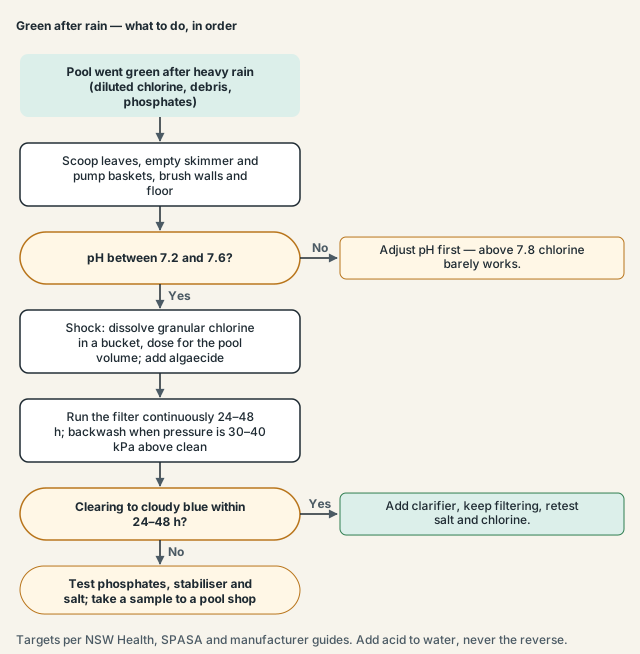
Safety first: handle pool chemicals in a ventilated area, wear gloves and eye protection, always add acid to water (never water to acid), and never mix chlorine products. Electrical work on pumps and chlorinators is licensed work in Australia. Shock products are strong oxidisers — dissolve granules in a bucket of water, never the other way round, and keep liquid chlorine off skin and clothing.
Why does rain turn a pool green?
Rain does four things at once. It dilutes the chlorine, salt and stabiliser already in the water; it carries algae spores, leaves and phosphates in from the air and garden; run-off shifts pH and alkalinity; and on a salt pool it can push the chlorinator into Low Salt so it makes less chlorine just when more is needed.
Lo-Chlor notes that "algae spores are always being deposited into your pool from the air and from rain". Poolwerx's storm guide adds that "phosphates get deposited into your water" and that run-off can "alter your water's pH, calcium hardness, total dissolved solids, alkalinity and other chemical levels". Phosphates are algae food; Zodiac says they "should be kept below 500 ppb".
The pH shift is the quiet one. Hy-Clor puts it bluntly: "If your water's pH reaches over 7.8, it stops chlorine doing its job", and Zodiac states that at pH 8 chlorine is "about 25% effective". A pool that still shows some chlorine on a strip can go green anyway.
On a salt pool there is a fourth blow. AstralPool's eQ manual lists "rain" alongside backwashing and leaks as a cause of low salt, and a unit showing Low Salt cuts output. The AstralPool Low Salt page explains what that message does and does not mean.
One exception: water that is green but clear is usually dissolved copper or another metal, not algae. Lo-Chlor says that case needs a metal sequestrant, and shocking will not fix it.
Test first and fix the pH
Before any chlorine goes in, test pH, free chlorine and, on a salt pool, salt. NSW Health's advisory document says "pH should be maintained between 7.2-7.6 because more hypochlorous acid is available for disinfection", and SPASA recommends the same band, with "7.0 to 7.2 for fibreglass pools". Zodiac asks for 7.2–7.6 before shocking; AstralPool says 7.0–7.4 for a dark-green pool.
If pH is high, correct it with acid added to the deep end with the pump running and re-test after an hour. Total alkalinity should sit around 100–120 ppm (SPASA), which stops pH bouncing while you work. If stabiliser has been diluted below 20 ppm, Zodiac's season-opening guide says to add cyanuric acid after the shock has done its job; NSW Health caps it at 50 mg/L.
How much shock does a green pool need?
The target for a green pool is roughly 10 ppm of free chlorine, three to five times the normal 2–4 ppm. NSW Health's chlorine ready reckoner gives the base rates: per 10,000 L, 1 mg/L needs 80 mL of 12.5% sodium hypochlorite (liquid chlorine) or 15 g of 65% calcium hypochlorite. Scale those by your litres and by the ppm you want to add.
Worked example for a 50,000 L pool that tests at 0 ppm and needs +10 ppm:
- Liquid chlorine 12.5%: 80 mL × 5 (for 50,000 L) × 10 (ppm) = 4,000 mL, about 4 L.
- Calcium hypochlorite 65%: 15 g × 5 × 10 = 750 g (about 770 g at the reckoner's rounding, or 715 g for a 700 g/kg product).
Manufacturer pages land close to that. Hy-Clor lists "between 100-170 grams per 10,000 litres as the initial shock treatment" for granular chlorine, so 500–850 g for 50,000 L. Zodiac's Pool Chlorine (700 g/kg) says to "dissolve the product in a bucket of water, and then apply the solution to the pool", and its green-pool page prescribes, for a 50,000 L dark-green pool, "1kg of Ezy Sanitiser and 2.5L Pool Power Algaecide". AstralPool uses 2 kg of Purifier plus 2.5 L of algaecide for dark green, with a second 2 kg "if pool doesn't turn milky after 4 hours", without stating a volume. BioGuard's rule is "one bag of BioGuard Burn Out Extreme to every 50,000L" for light green and "two treatments" for dark green. Algae add their own chlorine demand, so keep testing and re-dose until free chlorine holds overnight.
Algaecide, clarifier or flocculant?
Algaecide goes in after the shock and keeps working while the filter runs; Zodiac's opening guide gives an initial dose of "typically 90mls per 10,000 litres", and its green-pool page pairs 2.5 L with the shock for 50,000 L. Clarifier and flocculant are for what is left once the algae is dead, and they do different jobs.
Zodiac describes clarifier as "a maintenance product used to restore shine to slightly cloudy water" and flocculant as something that "binds to small particle impurities" so they sink and can be vacuumed to waste. Poolwerx reserves floc for brown, muddy water, where it settles the load in "3-6 hours". Zodiac's advice is "add 500ml liquid clarifier after 24 hours if needed". One caution: Zodiac says "copper-based algaecides should not be used in ionised pools", and copper can itself tint water green.
Filter for 24–48 hours and clean the filter
Every manufacturer page says the same thing about circulation: run the pump continuously. Zodiac says "run the filter continuously for 24-48 hours" after a green-pool shock, AstralPool says at least 24 hours, and BioGuard says to "run your pool filter and pump continually during the treatment". Zodiac's season-opening guide stretches that to "48 to 72 hours continually" for a pool that has been sitting.
Brush the walls and floor daily; BioGuard calls brushing "critical" because it lifts algae off surfaces where chlorine cannot reach. A media filter loads up quickly with dead algae. AstralPool's filter manual says to backwash "when pressure gauge indicates 30 to 40 kPa higher than at starting pressure", for "3-5 minutes or until sight glass runs clean", then "always rinse for 1 minute after each backwash". Cartridges get hosed out when the gauge rises. Each backwash also removes salt and stabiliser, so re-test both once the water is clear.
Salt pools: retest salt and use boost
A salt pool has one extra step. Rain and backwashing both dilute salt, and the AstralPool, Zodiac and Davey manuals all treat dilution as the main reason for a Low Salt reading. Test with a strip or take a sample to the shop, and if the reading is below your unit's target, add salt now so the chlorinator can carry the load once the pool clears.
The how much salt to add page has the formula and a brand table; the pool salt calculator does the kilograms. Salt takes about 24 hours to dissolve, so day-one shock still comes from a bottle or bag. Once the level is right, set the chlorinator to boost — on Zodiac's eXO that is 100% output for 24 hours — until free chlorine holds at 2–4 ppm without help. Cold water below about 15–16 °C gives a false Low Salt reading, so a winter storm may not have diluted anything.
What to check before you call a pool shop
Most green pools clear with the steps above and never need a service visit. Before booking one, run this list; a pool company will ask the same questions, and the answers decide whether a visit is worth paying for or whether a second full shock will do.
- Re-test pH. Above 7.8, chlorine is being wasted; correct it before adding more.
- Test free chlorine morning and evening. Back to 0 ppm within hours means the algae are still alive and the pool needs another full shock.
- Check stabiliser. Zodiac asks for 30–50 ppm before shocking; above 100 ppm chlorine is locked up.
- Test phosphates. Zodiac's "still green after shocking" page lists phosphates and metals as the two usual reasons.
- Check the filter. Gauge 30–40 kPa above clean means backwash; a cartridge that will not come clean needs replacing.
- Confirm run time. Hy-Clor asks for at least 8 hours a day normally, and continuous while clearing algae.
- Look for the exceptions. Clear-but-green water (metals), copper algaecide history, or a black-green pool that BioGuard refers to a professional.
If the pool is still green after 48 hours of continuous filtering with pH at 7.2–7.6 and chlorine holding overnight, the likely culprits are phosphates above 500 ppb, metals, or a filter that is not filtering. Take a sample to the shop for a full analysis.
Keeping the next storm from doing it again
Prevention is cheap. Before forecast rain, get free chlorine to the top of the normal band and pH to 7.2–7.4, so dilution lands you inside the range rather than below it. After rain, empty skimmer baskets, skim leaves, test and correct the same day, and run a longer filter cycle than usual.
On a salt pool, check salt after any rain that raised the water level. BioGuard recommends weekly algaecide, and Lo-Chlor pairs a long-life algaecide with a phosphate remover for pools that keep blooming.
Frequently asked questions
How long after rain does a pool go green?
It depends on how much chlorine was in the water when the rain hit. A pool at 3 ppm with correct pH and stabiliser will often shrug off a storm; one already at 1 ppm can turn within a few warm days. Zodiac notes chlorine can drop by up to 90% on a hot day, so summer storms turn pools fastest.
Can I just run the salt chlorinator harder instead of shocking?
Rarely fast enough. A 25 g/h cell needs roughly 20 hours to lift a 50,000 L pool by 10 ppm even with no algae demand. Shock from a bottle gets the pool to 10 ppm in minutes; the chlorinator on boost then holds it while the filter does its work.
Is it safe to swim while the pool is being shocked?
No. Free chlorine at 10 ppm is well above the 1–3 ppm range the chlorinator manuals give for swimming. Wait until free chlorine tests back inside the normal band and the water is clear enough to see the deep-end floor.
Sources and manuals checked
pH and chlorine targets are from NSW Health and SPASA; the per-10,000 L doses are from the NSW Health ready reckoner, written for water tanks but the same chemistry. Product doses are quoted from Zodiac, AstralPool, Hy-Clor and BioGuard. AstralPool's page does not state a pool volume and BioGuard does not state a bag mass, so neither has been converted to a per-litre rate.
- NSW Health — Public Swimming Pool and Spa Pool Advisory Document (2013), pH and free chlorine (authority)
- NSW Health — Chlorine Ready Reckoner Tables (Private Water Supply Guidelines) (authority)
- SPASA Australia — Water Balance (authority)
- Zodiac Australia — How To Test And Fix A Green Pool (official)
- Zodiac Australia — 5 Reasons Why Your Pool Is Still Green Or Cloudy After Shocking (official)
- Zodiac Australia — Opening Your Pool For The Season (official)
- Zodiac Australia — Pool Chlorine WPQPC7002 (calcium hypochlorite 700 g/kg) (official)
- Hy-Clor — Green Pool Recovery: If My Pool Is Green What Do I Do? (official)
- Hy-Clor — Chlorine Sanitisers (initial shock and daily doses) (official)
- BioGuard Australia — Help! My Pool's Turned Green (official)
- AstralPool — 5 Simple Steps to Fix a Green Pool (official)
- AstralPool — CA & ECA Media Filter Manual, Inst.368 (backwash pressure) (official)
- AstralPool — Viron eQ Salt Chlorinator Installation Manual, INST 464 (rain listed as a dilution cause) (official)
- Lo-Chlor — Why Is My Swimming Pool Water Turning Green? (official)
- Poolwerx — Rain & Storm Pool Guide (secondary)