Panasonic H11 error code
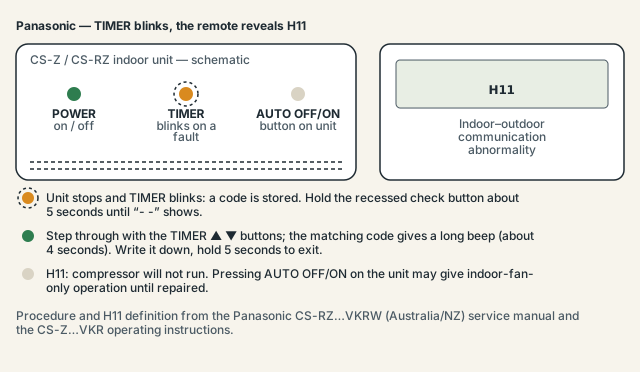
Panasonic H11 is an indoor–outdoor abnormal communication fault: the indoor unit is not receiving normal data from the outdoor unit. The system stops and the TIMER lamp blinks. Panasonic's causes are a faulty circuit board, improper wiring between the units, or broken connection wires. Owners can power-cycle once and run the indoor fan; the rest is licensed work.
Safety first: in Australia, anything involving refrigerant needs an ARC-licensed technician, and anything behind an electrical cover needs a licensed electrician. Everything on this page is limited to checks you can do from outside the unit with the power off at the switchboard. The H11 diagnosis is a series of voltage measurements at the terminal blocks of both units — that is licensed electrical work in every state and territory.
What does the Panasonic H11 code mean?
Panasonic's AU/NZ service manual for the CS-RZ…VKRW series lists H11 as "Abnormal communication" between the indoor and outdoor units. The indoor unit checks the data it receives from the outdoor unit "during startup and operation of cooling and heating"; when that data is not normal for a continuous five seconds, the indoor unit raises H11, stops the system and blinks the TIMER lamp.
The service manual's H11 page lists three causes, and they are all on the link between the two units: a faulty indoor or outdoor PCB, "improper wiring between indoor and outdoor units", and "broken connection wires". It is not a compressor code, not a refrigerant code and not a sensor code. The two boards simply cannot hear each other.
If the code appeared after a blackout, a storm or a tripped breaker, the boards may have restarted out of step and one clean power cycle can clear it. If it keeps coming back, no amount of button-pressing will fix it — someone has to measure what is on the wire.
Why is the TIMER light blinking?
Because that is how a Panasonic wall split reports any stored fault. The user manual says: "If the unit stops and the TIMER indicator blinks, use the remote control to retrieve the error code." The service manual adds that the TIMER LED keeps blinking while the unit is in the breakdown condition and goes off only when the power is cut.
A blinking TIMER lamp on its own does not tell you it is H11; it could be any of the H or F codes further down. The remote's check mode converts the blink into a number. One lamp state that is not a fault: a blinking POWER indicator before operation is "a preliminary step in preparation for the operation when the ON timer has been set" — normal.
How do I read the error code on a Panasonic remote?
Hold the recessed check button on the remote for five seconds until the display shows "- -", then step through the codes with the TIMER ▲ and ▼ buttons starting from H00. When the displayed code matches the stored one, the POWER lamp lights for 30 seconds and the unit beeps continuously for about four seconds. Hold the button five seconds again to exit.
The procedure is the same in the CS-Z…VKR operating instructions and the RZ service manual, but the button is labelled differently. The service manual calls it CHECK; the operating instructions show a pictogram that the copy read for this page rendered as SET. Either way it is the small recessed button that needs a pointed object, not one of the main keys. Written out:
- With the unit stopped and the TIMER lamp blinking, press the recessed check button and hold it for 5 seconds. The display changes to "- -".
- Press TIMER ▲ or ▼ to step through the codes. Codes that do not match light the POWER lamp for half a second with no sound.
- When you reach the stored code the unit beeps for about 4 seconds and the POWER lamp stays lit for 30 seconds. Write the code down.
- Hold the recessed button for 5 seconds again to leave check mode.
- The manual's final step: "Turn the unit off and reveal the error code to authorised dealer."
The service manual notes that "the last error code (abnormality) will be stored in IC memory", so the code survives a power cut. Clearing that memory is done by pressing the check button briefly until the unit beeps; the service manual lists it as a technician step, so leave the stored code in place for whoever comes to look.
Can I still use the air conditioner with H11?
Only the indoor fan. The error table gives H11 an emergency operation of "indoor fan only operation": press the AUTO OFF/ON button on the indoor unit itself, and the unit runs its fan without the compressor. The user manual describes the same thing as restarting "for limited operation if there are 4 beeps when operation starts". It moves air; it does not cool or heat.
Emergency operation gets you through a hot night; it is not a fix. The compressor will not run with H11 active because the indoor unit cannot send it instructions.
What to check before you call a technician
Everything here is done from outside the units with the power off at the switchboard. Panasonic's own instruction once the checks in the user manual do not resolve the problem is to "turn off the power supply and consult authorised dealer". Five minutes of preparation gives the technician a head start and may save a return visit.
- Read the code first. Use the check-mode procedure above and write down the exact code and the model number from the indoor unit's sticker (for example CS-Z50VKR).
H11andH33can look alike from across the room; they are different jobs. - Do one power cycle. Switch the unit off with the remote, switch the breaker off at the switchboard (and the outdoor isolator if there is one), wait a few minutes, switch back on and restart. Panasonic's manuals do not give a wait time. If
H11is a leftover from a power event this clears it. - Listen for the outdoor unit on restart. If it never hums or spins, the outdoor unit may have no power at all, and
H11is the symptom rather than the fault. - Look at the interconnect cable. Follow the conduit from the indoor unit's wall to the outdoor unit. Crush damage, chew marks, exposed copper or a cable pulled from the outdoor cover is your answer. Do not open the cover; the terminal block carries 240 V.
- Check the outdoor isolator. A rotary isolator next to the outdoor unit can be knocked off by a mower.
- Use fan-only if you must. The AUTO OFF/ON button on the indoor unit gives you indoor fan only. It is not a reset.
- Note what preceded the code — storm, blackout, solar installation, roof or fence work near the cable run.
If the code clears and stays clear for a week, treat it as a one-off. If it returns within days, stop resetting and book the visit.
What the technician will do
The service manual's H11 flow is a set of voltage checks. The technician measures 230–240 V AC across outdoor terminals 1 and 2, then a fluctuating 10–70 V DC across terminals 2 and 3 — the communication signal — and repeats the same measurements at the indoor terminal block. A missing or wrong reading points to the power supply, the communication circuit or the terminal connections.
If power and wiring test correctly and the signal is still absent, the manual's instruction is to replace the PCB whose communication circuit is faulty. Every measurement is taken on live terminals behind an electrical cover, which is why H11 is a licensed job in Australia. Other brands follow the same logic — Daikin's U4 and Fujitsu's E:11 (behind the E:EE flag) are the same fault, and Mitsubishi Electric shows it as a continuous half-second blink. If the diagnosis ends in a board on an older unit, the running cost calculator shows what a newer system would save per summer.
Common Panasonic H and F codes
H11 is one row in a two-page table. The rows below are the ones most likely to come up on an Australian wall split, taken from the CS-RZ…VKRW service manual. H00 means no fault is stored. Two of them — H98 and H99 — are protection codes where Panasonic's first listed check is a dirty air filter, the one item that is yours to fix.
Table: Selected Panasonic H and F codes (CS-RZ…VKRW AU/NZ service manual)
| Code | Meaning | Emergency operation / first check |
|---|---|---|
H00 |
No memory of failure (normal) | — |
H11 |
Indoor/outdoor abnormal communication | Indoor fan only; check connection wire |
H12 |
Indoor unit capacity unmatched (multi) | Indoor fan only; check combination table |
H14 |
Indoor intake air temperature sensor abnormality | Sensor |
H16 |
Outdoor current transformer (CT) abnormality | Outdoor PCB or compressor |
H19 |
Indoor fan motor mechanism lock | Fan motor lead wire and connector |
H23 |
Indoor heat exchanger temperature sensor 1 abnormality | Sensor |
H27 |
Outdoor air temperature sensor abnormality | Sensor |
H28 |
Outdoor heat exchanger temperature sensor abnormality | Sensor |
H33 |
Indoor/outdoor misconnection (wrong voltage or pairing) | Judged within 2 seconds of power-on |
H97 |
Outdoor fan motor mechanism lock | Fan motor lead, connector, lock or blockage |
H98 |
Indoor high pressure protection (heating) | Indoor heat exchanger, dirty air filter, airflow short circuit |
H99 |
Indoor freeze protection (cooling) | Indoor heat exchanger, dirty air filter, airflow short circuit |
F11 |
4-way valve switching abnormality | Reversing valve |
F90 |
PFC circuit protection | Outdoor PCB |
F91 |
Refrigeration cycle abnormality | Insufficient refrigerant or valve closed — ARC-licensed |
F93 |
Compressor abnormal revolution | Power transistor module or compressor lock |
F97 |
Compressor overheating protection | Outdoor air circuit (fan), insufficient refrigerant |
If you get H98 or H99, clean the filter and make sure nothing is blocking the indoor unit's intake before you ring anyone; both are protection trips, not component failures. Everything with "refrigerant" in it is ARC-licensed work.
Frequently asked questions
Can I reset a Panasonic H11 error myself?
You can do one power cycle at the breaker, which restarts both circuit boards and clears an H11 caused by a power event. The stored code stays in memory until a technician clears it. There is no remote-control reset for H11; if it returns after a power cycle, the wiring or a board needs a licensed technician.
Does H11 mean the outdoor unit is broken?
Not necessarily. H11 says the indoor unit is not receiving normal data from the outdoor unit. That can be a supply glitch, a damaged interconnect cable, a loose terminal, or a PCB on either side. Whether the outdoor unit powers up at all after a restart is the best clue you can give the technician.
Why does the unit run the fan but not cool?
Because H11 allows "indoor fan only operation" as its emergency mode. When you press the AUTO OFF/ON button on the indoor unit, or restart and hear four beeps, Panasonic lets the fan run so you have air movement. The compressor cannot run without communication from the indoor unit, so there is no cooling or heating.
Is H11 the same as H33?
No. H33 is an indoor/outdoor misconnection — the wrong pairing or voltage class, judged within two seconds of power-on — and shows up on new installations or after a unit swap. H11 is a communication failure on a correctly matched pair. Both involve the interconnect, but H33 is an installer question and H11 is a repair.
Will a dirty filter cause H11?
No. Filter problems on a Panasonic show as H98 in heating or H99 in cooling, where the manual's first check is the air filter. H11 is purely the data link between the units. Clean the filter anyway while the unit is off; it is the one maintenance item Panasonic's manual leaves to the owner.
Sources and manuals checked
The meaning of H11, its causes, the "indoor fan only" emergency mode and the technician voltage flow are from the Australia/New Zealand-destination CS-RZ…VKRW service manual; the retrieval procedure and TIMER-lamp wording are from the CS-Z…VKR operating instructions, whose printed button label was read as SET where the service manual says CHECK. Panasonic's customer-facing H11 support article could not be read, and no Panasonic document gives a call-out cost, so none is quoted.
- Panasonic — CS-RZ25–71VKRW / CS-RZ80VKR with CU-RZ…VKR Service Manual (Australia/New Zealand), self-diagnosis p. 120, error code table pp. 121–122, H11 p. 123 (official)
- Panasonic — CS-Z20–80VKR Operating Instructions ACXF55-22380, troubleshooting pp. 16–18 (official)
- Panasonic — CS-Z20VKR Service Manual (official)
- Panasonic — CS-RZ25TKR / CS-RZ35TKR Troubleshooting Manual (official)